Saturday, December 29, 2012

Overbrook in Winter

From the Rideau Tennis club down to the Queensway, is a snow covered wonderland during the winter of 2012. It would be much appreciated if the NCC could find a way to plough the path as the city has found a way to plough from Hurdman to the bridge.

Sunday, November 25, 2012

Community Development in Overbrook - You don't have to be starving in Africa


These pillars are directed at empowering the entire community to break the cycle of poverty
  • education, 
  • alternative income and livelihood, 
  • health care, 
  •  clean water and sanitation, and 
  • agriculture and food security.

 Create community projects designed to be owned and maintained by the community, and self-sustained within five years after project implementation is complete.

  • promote solidarity, not charity.
  • learn and share with community members in order to gain a valuable experience.
  • begin making a difference, armed with a new perspective and understanding of our role in the global community.
  • Hands-on volunteering and the opportunity to give back in a meaningful way
  • Social issues education
  • Renewed sense of community: Helping to redefine the sense of empathy, compassion and a full understanding of the power of communalism.
  • Action planning: All participants set goals and build personalized action plans

Engaging and collaborating with local community members at the outset of any development project in order to address the issues that community members have identified as important.

Developing and building the capacity of community members to assume leadership and management of the implemented projects.

Providing families (especially women) with opportunities to participate in alternative income and micro-credit programs, and equipping them with the skills and tools—such as financial literacy training, business planning workshops and leadership seminars—to be successful entrepreneurs and give back to their community.

Developing the potential of "merry go rounds" (and other similar traditional lending and savings initiatives) to increase income and livelihood for families.

Tackling local environmental issues and providing solutions based on indigenous knowledge to ensure programs can be sustained by both community and the land.


Saturday, November 17, 2012

Rental Property Availability in Overbrook - from CMHC

http://www.cmhc-schl.gc.ca/odpub/esub/64423/64423_2011_A01.pdf?fr=1327677462350

Friday, November 16, 2012

The Problem with the Cummings Bridge


The sidewalk is simply too narrow and the roadway too close to the sidewalk, watch out for the rear view mirrors of buses, and dumptrucks. They may take your head off! My suggestion is to remove the north sidewalk and widen the south sidewalk. Move the bike lane to the south side as well and separate it from traffic using bollards.

Cycling on the Cummings Bridge

Cycling in Ottawa is growing exponentially and continues to be safe, says the inaugural annual report from Citizens for Safe Cycling.

all taken from

http://www.ottawasun.com/2012/07/28/cycling-in-ottawa-growing-and-safe-report

kelly.roche@sunmedia.ca
@ottawasunkroche


"More and more people discover that if you sit down and figure out a route, 95% of the route is just fine," said CFSC president Hans Moor.
"It is often a crossing here, an oddly designed shoulder there, that gives a perception that cycling is not safe. But it is."
The recently released document combines National Capital Commission and municipal initatives, examining the state of cycling in Bytown.
An estimated 300 accidents were reported each year between 2007 and 2010 but that figure remains constant, even with an increase of riders, the report finds.
It highlights improvements made since 2010, such as better signage at the train culvert on Carling Ave. between Herzberg Rd. and Moodie Dr.
In addition, better lighting and signage have been installed at the University of Ottawa underpass so cyclists can ride below Nicholas St. and the Transitway, linking them with the Corktown Bridge.
Other areas lack progress, such as a bypass for cyclists to the Merivale Rd. shopping strip, and signage to get downtown from the Ottawa River pathway.
"Many of our indicated problems need more than a year to put into place," said Moor.
"The city is definitely listening, but going through the motions takes awhile."
Connections such as the Byron-Tyndall-Gladstone are currently being studied.
The group is also asking the city to focus on linking Laurier Ave. with the Ottawa River pathway, and Bank St. near Billings Bridge.
"Not everyone realizes that a bike network is incredibly cheap," said Moor.
"Ottawa has many parts in place already, and if we fix a number of problem spots, we all of a sudden have a complete network."
The growth of cycling is so overwhelming, there isn't enough parking, said Moor.
Meters were replaced with pay and display kiosks, however, more spots will become available as the city redevelops areas such as Bank St. in Centretown and Wellington St. W.
The site parkmybike.ca is user-driven, pointing out areas with and without adequate facilities.
The NCC, though, is doing well with its Park-and-Cycle program.
The 2011 pilot project saw 360 spots for commuters who partially drove to work, parked for free in a lot, then cycled.
The NCC confirmed the program is ongoing until Nov. 15, weather permitting.
kelly.roche@sunmedia.ca
@ottawasunkroche

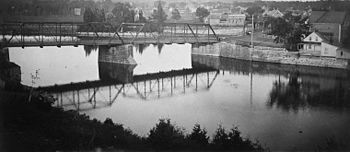
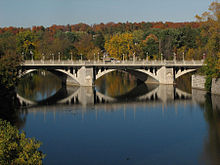
Cummings Bridge

Before


http://upload.wikimedia.org/wikipedia/commons/thumb/2/2c/Cummings_Bridge_Ottawa_1896.jpg/350px-Cummings_Bridge_Ottawa_1896.jpg

After

http://upload.wikimedia.org/wikipedia/commons/thumb/9/9f/RideauRV.JPG/220px-RideauRV.JPG


Beautiful but ...


The first Cummings Bridge, erected in 1836, linked Bytown and Gloucester. The bridge crossed the Rideau River, via the island lying just south of today's bridge, where the Cummings family lived and ran a general store. A community called Cummings Bridge sprang up in the surrounding area. This community would eventually become known as Vanier.
The early wooden bridge was replaced first by the Cummings family (who charged a toll for the new bridge) and again later by Ottawa lumberman (and later mayor) Samuel Bingham in 1893. In thanks for Bingham's investment, the City renamed the bridge after him. However, angry community residents tore down the name plaque and threw it in the river. As a result, we still know the bridge as Cummings Bridge.
Today's bridge, built in 1921, is the bridge's fourth incarnation. In the summer, you can often spot Ottawa's royal swans from the bridge or the nearby banks of the Rideau River.

taken from :
http://capitalneighbourhoods.ca/english/sandy-hill/story-266.aspx


The  bridge promoted the migration of working-class families from Bytown to what became Vanier. At the beginning of the 19th century, the lumber industry was a catalyst for the development of the region. The soon-to-be capital needed food as well as products and services from the surrounding countryside. Originally, Vanier had an agricultural calling, with many gardeners and farmers settling in the area.
The Cummings were located on an ideal site. First, they opened a general store to serve pioneering families from Junction Gore, the area that encompassed the headland at the junction of the Rideau and Ottawa rivers. Under the management of Robert Cummings, eldest son and heir of the family business, the store flourished and rapidly became a regional supply centre. Gradually, Robert Cummings diversified his activities and began to manufacture horse-drawn carriages. His general store was also the only one to hold a post office and, later, the only telephone service in town. As a prominent citizen, he was involved in local politics for almost 50 years.
After 1845, both the population and traffic rapidly increased in the region. Robert Cummings undertook the construction of a second, stronger wooden bridge. He collected a toll from its users. The City of Ottawa built a metal bridge in the early 1890s to meet more adequately the needs of the community. Much more than a link between the two shores, Cummings Bridge allowed the continued development of businesses in Janeville, Clandeboye and Clarkstown.
The Island Today…
Around 1920, the City of Ottawa decided to build a new bridge on the Rideau River a dozen metres to the north of Cummings Island. The new bridge, which no longer spanned the island, nevertheless kept the name of Cummings Bridge. In 1922, the City of Ottawa bought the island and demolished the general store of the Cummings. No one has inhabited the island since. The only architectural remains on the island are the bridge pillars built in 1890. In the 1990s, the municipal council of Vanier proposed to acquire the island and rebuild the general store to create a local heritage site, but the plan never materialized.

 Taken from : http://www.museoparc.ca/circuitvanier/circuit-vanier-2/montreal-road-circuit/cummings-island/


Overbrook Hip Hop